Showing posts with label astronomy. Show all posts

Thursday, January 10, 2013

Earth-like planets are fairly common in our Universe?

NASA's Kepler Mission that started three years ago has already discovered thousands of potential Earth-like planets, the so called exoplanets. This pioneer mission could hold great future importance as the astronomers look for new habitable planets outside our solar system.

It is very likely that one day space travel will be as common as taking a plane flight but prior to going further to space we need to gather as much of useful data as possible. As always, preparation is the key for successful travel, and in space travel even the small mistakes aren't allowed.

The NASA scientists have recently stated that „17 percent of all sun-like stars have planets one to two times the diameter of Earth orbiting close to their host stars.“ However, the current limitation of Kepler's detection capability suggests that this percentage could be lot bigger, some say even up to 50 percent.

The U.S. astronomer Andrew Howard from the University of Berkeley made the interesting observation by saying that „the frequency of planets increases as you go to smaller sizes, but it doesn't increase all the way to Earth-size planets as it stays at a constant level below twice the diameter of Earth“.

One other important fact is that planet doesn't have to be necessarily habitable just because it is one to two times the size of Earth and orbits around its Sun. Planets could turn out to be worlds with rocky core, similar to Uranus or Neptune, or could even turn out to be water worlds, covered with extremely deep oceans.

How does Kepler telescope work? In order to find planets, the Kepler telescope captures repeated images of 150,000 stars in a region of the sky in the constellation Cygnus, and afterwards the captured images are being analyzed by the advanced computer software.

Many astronomers believe it’s only a matter of time before new Superearth will be discovered. The road to space colonization is long and hard but the pioneering work of Kepler telescope will no doubt be forever remembered in the history of the human race.

Read more...

Monday, November 12, 2012

Space radiation still presents major obstacle to further exploration of our universe


Space is indeed a final frontier like they say it in Star Trek series and movies. However, before conquering this final frontier human civilization will have to reach tremendous scientific and technological advancement. In this sense, a good first step would be to solve the issue of space radiation that would enable astronauts to go further in their exploration of the Universe.

Prior to being able to solve this issue scientists need to fully understand radiation in space environments and this can will require advanced instruments in space vehicles. One of these advanced instruments is also the device called Advanced Neutron Spectrometer (ANS).

ANS operates by monitoring neutrons. This is an instrument that is specifically designed to do just this. Measuring neutrons is important because it gives scientists the necessary data about the amount of radiation astronauts are being exposed to. This instrument can read levels of radiation in the spacecraft or habitat and according to this data astronauts can employ adequate techniques to minimize their exposure to space environment.

Technologically, it is very demanding to measure neutrons because they are electrically neutral particles and thus pass through most detector systems without being detected. This is the reason why ANS design had to be special. This special design uses the gate and capture technique that aims to slow down the neutrons and then capture them in an isotope of Lithium.

Afterwards, special glass fibers loaded with Lithium are used to absorb the slowed down neutrons and produce a small flash of light unique to the neutron capture process thus enabling ANS electronics to process and analyze the radiation levels.

The current results are very promising. Mark Christl, the ANS project leader at Space Flight Center said that „the goal is to continue this work to improve the instrument performance and our radiation monitoring capabilities for our astronauts and meet the future needs of exploring new destinations.“

Read more...

Monday, September 17, 2012

The number of exoplanets continues to grow


Exoplanet is by definition any planet outside our solar system. As of September 2012, astronomers have discovered more than 800 exoplanets, varying from scorching hot worlds with molten surfaces to extremely cold ice balls.

The astronomers hope that one day they will be able to find new Earth, the so called “Superearth”, a planet with roughly the same characteristics as Earth, the one that has the ability to sustain life.

The quest for this planet still goes on but nonetheless researchers say that life might actually be able to survive on some of the currently found exoplanets, despite the extreme conditions. Of course, if there were to be life on these planets then this would have to be some extreme life forms.

The astronomers look for exoplanets in so called habitable zone, namely at just the right distance from its Sun. The habitable zone is „not too hot and not too cold“ area, primarily determined by the size and heat of the star.

The astronomers have also discovered that there are some exoplanets that only spend some time within the habitable zone because many of these planets travel in very oblong, eccentric orbits that vary greatly in distance from their stars. This means that conditions on these planets could exchange between very cold and extremely hot.

Even in these extreme conditions, there is still a chance for alien life on these planets. The researchers have already found certain forms of life on earth that can survive in long-lasting, cold or hot conditions.
Earth-based spores, bacteria and lichens, for instance, were able to survive in both harsh environments on Earth and the extreme conditions in our Universe.

These planets are unlikely to support human-like life forms but could still support other life forms such as lichens and bacteria, to survive.

We also need to know that our astronomical knowledge about the habitability on currently discovered exoplanets is very limited, subject to guesses and speculations, because scientists still don't posses any data about the atmosphere of these planets. 

The presumption that we should look life just on planets that look like our own doesn't have to be necessarily true, especially given the fact that we still have so many unanswered questions about the life on our planet. It's Universe, meaning everything is possible.

Read more...

Monday, September 10, 2012

Silver and gold did not originate together


The scientists are still conducting various studies in hope to thoroughly explain cosmic origin of heavy elements such as silver and gold. Most scientists agree with the theory that lightweight chemical elements such as hydrogen and helium came into existence moments after the Big Bang. This however wasn't the case with heavy elements such as gold and silver that materialized much later in the interior of stars or during supernovas.

The previous presumption was that gold and silver both originate from the same kind of exploding stars but this is not the case according to a Heidelberg scientist Dr. Camilla Hansen who believes that silver and gold materialized in completely different star explosions.

Dr. Hansen came to this conclusion after observing that the amount of silver in the stars measured is completely independent of the amounts of other heavy elements like gold. What this means is that the supernova silver is completely different process as compared to supernova gold and that silver hadn't originate together with gold.

Silver and gold have therefore probably materialized from two different types of stars, namely stars with different masses.

Heavy elements such as gold, silver, iron were likely produced by supernovas of large stars (ten times the size of our Sun), with the deciding factor behind the creation of certain element being primarily the mass of the star.

Dr. Hansen said that „after this discovery, we must now use simulations of these processes in supernova explosions to investigate more precisely when the conditions for the formation of silver and gold are present so we can find out how heavy the stars were that could produce silver and gold during their dramatic demise.“

Read more...

Monday, August 6, 2012

The start of the new era of Mars exploration

The planet Mars, also called Red Planet, is still a subject of many controversial questions, with the most important question being whether the life ever existed on Mars or not. The NASA scientists hope that their brand new and most advanced rover Curiosity that has just landed on Red Planet will give them plenty of new info about the history of Mars.

Curiosity is the most complex rover ever sent into space, and after a very sophisticated landing it is already collecting valuable data, that will perhaps give the answer on not only was Mars once planet that supported life but also on whether Mars can sustain life in years to come.

The president Obama has already spoken about sending humans to Mars in 2030s, and this mission could tell us whether this president's bold vision has a chance to turn into the reality or not.

Curiosity will collect data for the next two years, hoping to find some kind of  microbial proof that would connect Mars with the possibility of life and future colonization by humans.

Curiosity will not only send thousands of images but is also equipped with 10 highly sophisticated science instrument such as high-tech lasers that are able to check the composition of rocks on Mars from a distance.

Robotic arms will be used to take soil samples and these samples will be then analyzed by analytical instruments located inside the rover.

There have already been some indicators suggesting that Mars used to have water on its surface. Will Curiosity finally provide us with enough proof about the wet history of the Red Planet? This, and many other questions, are still waiting to be answered.

Read more...

Monday, June 25, 2012

What is wrong about the concept of life on other planets?


Are we alone in the Universe? Many scientists believe that the answer to this question is no but we are yet to see concrete evidence about “aliens from other worlds”. Many ufologists would mention Roswell and several different conspiracy theories claiming that there are many proofs that we aren't alone in the universe. But we are still waiting for definite yes from the mainstream science.

The latest interesting news related to this topic comes from the University of New Mexico scientists who have studied two Martian meteorites that originate from the interior of Mars. 

By analyzing the water content in these meteorites the scientists have concluded that that the amount of water in places of the Martian mantle is much bigger than previously  estimated and is in fact similar to that of Earth's leading to conclusion that Mars could have sustained life.

Don't get me wrong ,there is nothing wrong with this conclusion. Mars could have indeed had plenty of water in the past. And yes, this could have result in life on Mars so the conclusion is definitely right but the concept needs some expanding, on my opinion that is.

I for one, do not agree that water and oxygen are necessary ingredients to support life in entire universe, life like ours yes, but general life no. Given our highly limited knowledge about the Universe and our own existence, I believe that it is totally wrong to start with the assumption that water and oxygen are necessary substances for life to develop on other planets.

We can judge the life from the extremely limited perspective given the vastness of our universe so we should definitely expand our current concept of life on other planets.

Who gives us the right to categorically refuse the possibility of life on other planets just because there is no water or oxygen? Who knows what kind of strange and unknown elements and liquids exist in Universe, substances that will perhaps be discovered by our future generations giving completely new light on the definition of life itself?

Our current hunger for knowledge is positive thing, something that moves our civilization forward through technological and scientific innovations. However, in order to fully embrace this growth in knowledge we need to keep all our concepts open, especially the most important one, the concept of life.

Read more...

Monday, June 4, 2012

Is astronomy an exact science?

Astronomers in NASA, despite gathering plenty of knowledge throughout the more than half of century of NASA's existence, still aren't able to answer the most important questions such as the origin of our universe and origin of ourselves for that matter.

Whether we like it or not, astronomy is still not an “exact science”, where predictions heavily outweigh scientific facts. Our current level of knowledge and technology is simply not sufficient to offer more than some bold predictions that may turn out to be true in the end but not necessarily so.

The same thing can be applied with the latest NASA prediction that our Milky Way Galaxy will cease to exist in approximately 4 billion years time, after its collision with nearby Andromeda galaxy. Once this collision of galaxies occurs, the stars and planet should be thrown into different orbit around Milky Way's core - including our Sun, and this will mean the end of the Universe as we know it.

This is more an assumption than the actual fact. The NASA scientists do have their models but who can say with certainty that these models are 100% reliable, given our current level of astronomical knowledge?

They say that the neighboring Andromeda galaxy is approaching to our galaxy at roughly 250,000 miles per hour and that the distance between these two galaxies is currently 2.5 million light-years.

When exactly did the scientists witness the merger of two galaxies in order to know what exactly will happen if these two galaxies really collide in 4 billion years time? And we are talking here about the timespan of 4 billion years. Let’s just say that lot of „unexpected things“ can happen in 4 billion years.

The scientists also say that up to recently it was extremely difficult to determine whether the two galaxies would collide but now they know for certain that this crash will happen.

There aren't that many certainties in today’s astronomy, and predicting something that should happen in 4 billion years is anything but certain. The astronomers used extremely powerful cameras to capture the measurements that gave them crucial information about the motion of Andromeda. Well' don't be surprised if in not so distant future some more powerful cameras tell completely different story about the destiny of these two galaxies.

Read more...

Monday, May 21, 2012

How things looked like at the beginning of the universe?


The Big Bang theory is still a dominant theory when talking about the birth of our Universe. It has been estimated that Big Bang occurred some 13.7 billion years ago.

The early Universe consisted of a hot, dense primordial soup of gases and particles but it hasn't stayed long in this state because of its rapid expansion which made it less dense and cooler.

The density in all areas of the Universe wasn't the same and has increased due to gravity and began to contract further, forming the first galaxies and stars. It has been estimated that the first galaxies and stars were born approximately 500 million years after the Big Bang.

Majority of astronauts believe that these first stars had gigantic size and that they primarily consisted of the simplest chemical elements, only hydrogen and helium. It took many years for first heavier elements to develop and it is believed that they were created by different nuclear processes in the first stars.

Hydrogen and helium still remain the most dominant elements in our Universe but without the creation of heavy elements there wouldn't be formation of planets and life as we know it.

Why is Big Bang theory generally accepted among the most astronomers? The science usually points to the fact that the main premises of Big Bang theory such as the expansion, the early hot and dense state, the formation of early stars and galaxies - have all been derived from many different observations that do not depend on any cosmological model.

As the science of astronomy continues to progress it is very likely that Big Bang theory will have to be refined in years to come. There are plenty new things waiting to be discovered in the vast unlimited spaces of our Universe.

Read more...

Monday, May 7, 2012

The theories about universe expanding


The modern science says that universe is expanding which means that there are no edges somewhere where universe would end. The entire concept of infinite universe is not that easy to imagine because one could always ask himself if there's no actual border then how could universe really expand itself and why is this happening.

No, the universe isn't expanding in a futile attempt to run away from Chuck Norris though this is also a very interesting concept . What we need to know about the expanding universe concept is that it primarily refers to expansion into space with no structures such as extra dimensions or an exterior universe

The modern theory about expanding universe originates from astronomer Edwin Hubble. After countless measuring of relative distances between stars and other space bodies he found the explanation of expanding universe as the only logical answer to accept.

To accept the fact that universe is constantly expanding means also accepting the fact that universe used to be smaller. This means that after the Big Bang universe started the process of constant expansion with no end in sight.

 This also means that our universe isn't in static state but is instead in the state of constant change – constant expansion of our universe.

The expansion of universe is also connected with its density. The matter in universe doesn't have the necessary density that would somehow slow down the expansion of universe which helps explain its constant expansion and the fact that expansion speed decreases more slowly with time.

Some scientists believe that our universe is finite. The finite universe doesn't necessarily imply edges, it rather implies that the space wraps around on itself. Eventually, under the finite theory the universe would likely recollapse on itself, possibly resulting in yet another big bang and the birth of brand new universe.

The universe expansion issue is still connected with plenty of hypothetical assumptions. Everybody with a basic knowledge about universe can theorize about it. The theory is all we have at this moment because mankind is yet to assemble „the starship Enterprise“ in search for answers at the final frontier.

Read more...

Monday, March 12, 2012

Interesting facts about asteroids

Asteroids, also called planetoids, are small Solar System bodies orbiting the Sun.

The main difference between asteroids and planets is that asteroids never grew large enough to become planets.

In the orbits of the planets Mars and Jupiter is the largest group of known asteroids - the area known as the asteroid belt. It has been estimated that asteroid belt contains between 1.1 and 1.9 million asteroids larger than 1 km (0.6 mi) in diameter.

The first asteroid discovery in history occurred in 1801 with the discovery of asteroid Ceres, by Giuseppe Piazzi, though it was considered a planet at the time. Ceres is currently the largest known asteroid.

Astronomers at the University of Tennessee, Knoxville, believe that about 20 percent of asteroids have their own moons just like planets do.

The NASA scientists believe that giant black hole at the center of the Milky Way may be vaporizing and devouring asteroids.

In November 2011 an asteroid the size of an aircraft carrier safely flew past our planet. The next known approach of an asteroid this size will be in 2028.

The difference between asteroids and comets is that asteroids are rocks that primarily circle the Sun between the orbits of Mars and Jupiter while comets on the other hand tend to have highly elliptical orbits taking them from the frozen extreme edges of our Solar System to within distances so close to the Sun that solar radiation causes material in the comet to vaporize and stream out, forming the characteristic comet's tails.

The scientists study asteroids primarily because they believe that their samples might give them better clues in explaining our solar system's formation and how life began on our planet. This is the main reason why asteroids are the primary goals of many robotic missions.

Asteroids are in fact leftovers that originated from the cloud of gas and dust (the solar nebula). The solar nebula is believed to have collapsed to form our sun and the planets about 4.5 billion years ago. According to this theory asteroids contain the original material from the solar nebula, and can therefore provide us with the information about the conditions in times of our solar system's birth.

Huge asteroid hitting the Earth is one of the main themes of many Sci-Fi movies, This scenario could also at some time in future occur in reality, causing massive damage to our planet. Many scientists believe that the last time huge asteroid hit the Earth it killed all the dinosaurs and most other life on our planet.

The scientists are already looking at potential defensive systems against huge asteroids going our way. British scientists for instance believe that we should build large spacecrafts (so called gravity tractors) in order to stop large asteroids from hitting the Earth.

Read more...

Monday, February 6, 2012

Mars is not a good place to start our space colonization?

Human population is constantly growing which will in business as usual scenario lead to overpopulation of our planet and need to search for new habitable planets and new Super Earths. If we were to judge by many of Sci-fi movies and literature Mars would be the perfect candidate to start the human space colonization but sadly the reality suggests something completely different.

Several recent studies showed that Mars has an abundance of ice which has led to a theory that the Martian soil may have what it takes to support life, namely the liquid water. In order to make conclusion whether Mars is habitable or not the scientists have spent three years analyzing data on Martian soil and the final result was not positive.

The scientists have concluded that Red Planet is too hostile for any life to survive on the planet's surface because of the super-drought that has kept Mars in arid state for more than 600 million years.

There is also a very interesting theory that Mars may have had a warmer and wetter period in its earlier history more than three billion years ago. The researchers have confirmed this and have discovered that the Mars has been exposed to liquid water for at most 5,000 years since its formation billions of years ago.

The soil on Mars is uniform across the entire planet as was shown by satellite imagery and previous studies which draws the conclusion that the liquid water has been on the surface of Mars for far too short a time for life to develop on its surface.

Some believe that the proof of previous life on Mars can still be found underground the surface and it is expected that future NASA studies will focus on Mars’ underground in search for evidence of previous life on Red Planet.

The extreme aridity of Mars makes future colonization of Red Planet impossible, at least when judging by today's standards. So far Mars definitely doesn't seem to be having any similarities with the new Super Earth. Nonetheless, the quest for life on other planets is still on.

Read more...

Monday, January 16, 2012

Milky Way galaxy is colored white

The science has just started discovering things about our galaxy and we are yet to answer the really big questions such as is there another life hidden somewhere in our galaxy. In the meantime science is determining different other interesting things and one of these things is also the color of our Milky Way galaxy.

At the 219th American Astronomical society meeting the astronomers have announced that our galaxy has white color and they compared it with "spring snow at an hour after sunrise or before sunset."

This white color refers to the color of our galaxy by looking outside and you may rightly ask yourself how did the scientists determine the color of our galaxy? This was done by comparing star types in other galaxies.

Why is important to determine the color of galaxy? The astronomers say that color can reveal various other interesting information about galaxy, for instance how old are the stars in the galaxy.

Professor Jeffrey Newman of the University of Pittsburgh said that they gathered data from the Sloan Digital Sky Survey, which included information about million other galaxies. By comparing this info with the things they already knew about the total mass in the Milky Way, the rate of star formation, the researchers were able to find near matches among other galaxies and eventually determined a precise measure of what color it must be.

The astronomers also announced that our Milky Way galaxy is not a cosmic rookie but still has a long way to go before entering the last year of its life.

Read more...

Monday, January 2, 2012

Supernova - Interesting facts

Term supernova refers to explosive death of some massive star characterized by an enormous amount of emitted energy. Supernova explosion emits incredible amount of energy- more energy that our Sun emits for its entire lifetime. The expanding shock waves from supernova explosions are also capable to create the formation of new stars. Our Sun, for instance, does not have enough mass to end its life as supernova. The earliest recorded supernova, SN 185, was recorder by Chinese astronomers in 185 AD.

The astronomers believe that supernova explosion occurs approximately twice every 100 years in our galaxy. This means that supernova explosion are relatively rare event within our Milky Way galaxy. Most galaxies have a supernova every 25 to 100 years.

The scientists have estimated that in order for Earth's ozone layer to experience damage from a supernova explosion, the blast would have to occur less than 50 light-years away. Luckily, all of the nearby stars capable of going supernova are located much further than this. The nearest supernova candidate is IK Pegasi (HR 8210), located at a distance of 150 light-years.

Theoretically, if there would to occur such near supernova explosion this would cause huge damage to our planet's ozone layer from massive X- and gamma-ray radiation that would induce a chemical reaction in the upper atmosphere converting molecular nitrogen into nitrogen oxides, causing major depletion of our ozone layer and exposing life on our planet to harmful ultraviolet light in the sun's rays.

The gamma ray radiation as a result from supernova explosion can also result in a birth of a black hole. As matter falls toward a nascent black hole, some of it becomes accelerated into a particle jet of enormous power, even capable to drill its way completely through the star before the star's outermost layers even have begun to collapse. A gamma-ray burst, if directly pointed at Earth, could cause major damage from up to 10,000 light-years away. So far, the closest gamma ray burst on record, known as GRB 031203, was 1.3 billion light-years away. Gamma ray bursts are thought to be the most powerful blasts in the Universe.

The closest supernova explosion witnessed in almost 400 years occurred in 1987, when a light from an exploding star in a neighbor galaxy, the Large Magellanic Cloud, reached Earth. It was appropriately named Supernova 1987A.

The main reason why astronomers study supernovas is to find some kind of signature behavior that would enable them to identify stars before they explode. Scientists can still only speculate whether stars give off a clear signal of impending blast or not.

Read more...

Monday, December 12, 2011

Exoplanets and space colonization

Astronomy is a fast developing science with an increased number of scientists who believe that humans could already be able to colonize other, earth-like planets. Many scientists also agree that humanity simply needs to find ways to live on other planets if it wants to avoid extinction in years to come.

The astronomers have recently discovered hundreds of planets that could potentially in future be used for human colonization. In order to explore these planets science will have to evolve to the point where long term space exploration could be done without harmful effects to health of astronomers. The science will have to overcome challenges of radiation exposure and musculoskeletal deterioration in order for humans to colonize and settle on other planets.

The planets that have potential to support life are called exoplanets. Most of the hundreds of exoplanets that have been detected to date have been found by the so called transit method, which detects a dimming in light as a planet moves in front of a star, or by looking for a wobble as a star is tugged by the gravity of an orbiting planet.

In September 2011, The astronomers at HARPS (The HARPS spectrograph on the 3.6-metre telescope at ESO's La Silla Observatory in Chile is the world's most successful planet finder) led by Michel Mayor (University of Geneva, Switzerland), have announced the discovery of more than 50 new exoplanets orbiting nearby stars, including sixteen super-Earths (planets with a mass between one and ten times that of Earth are called super-Earths, so far there hasn't been discovered any of these planets in our Solar system but apparently they seem to be very common around stars in other galaxies.). The pace of discovering new exoplanets is accelerating.

The astronomers have already coined the term the "habitable zone" which refers to the region around a star where a planet of Earth-like size, composition and atmospheric pressure can maintain liquid water on its surface. Under the currently available scientific knowledge liquid water is considered to be the prerequisite for life on other planets, though this doesn’t have to be necessarily true. Exoplanets orbit their sun at a distance where the temperatures on the planet's surface allow for the presence of liquid water.

Some scientists believe that the chances for finding life at habitable zone around low-mass stars are pretty bleak and that astronomers should focus more on finding new Sun if they are to find new Earth. One of these scientists is René Heller of the Astrophysical Institute Potsdam (AIP) who says that current astronomic science didn't include tidal effects into equation which significantly modifies the traditional concept of the habitable zone.

It is expected that in the next couple of years the number of exoplanets will reach thousands so science will have to limit their focus only on few of them, namely the ones that apparently exhibit the most Earth-like of conditions. The current number of exoplanets stands around 600.

Read more...

Monday, November 14, 2011

How dangerous are solar flares?

Without the Sun the life on our planet wouldn't be possible. But the Sun isn't always a good guy because of solar flares, huge bursts of electromagnetic energy and other particles coming from the Sun.

And since the Sun is currently entering the peak of its activity there are some who fear that in 2012 gigantic solar flare could even destroy Earth and confirm Mayan prediction about the end of the world.

The majority of scientists don’t share this opinion. The standard solar activity cycle which lasts for 11 years isn't something new and anyone over the age of 11 has already lived through such a solar maximum with no harm. Also to get the facts straight the next solar maximum is predicted to occur in late 2013 or early 2014, not 2012.

The Sun, even despite its enormous size doesn't have enough energy to send a killer solar flare 93 million miles to destroy Earth. This however does not mean that the increased solar activity will not affect our planet.

The biggest issue could be in form of coronal mass ejections that have the ability to propel bursts of particles and electromagnetic fluctuations into Earth's atmosphere which could in worst possible scenario blow out transformers in power grids and also disrupt electronics onboard a satellite.

The recent technological advances have enabled NASA to improve their predicting abilities about the solar flares, coronal mass ejections, and space weather in general. This means that NASA scientists can give early warnings to electric companies, spacecraft operators, and airline pilots before a coronal mass ejection reaches Earth so that they can take proper precautionary measures.

Read more...

Monday, November 7, 2011

Science close to creating a tractor beam

Tractor beam is a stuff from sci-fi movies most notably Star Trek and refers to ability to trap and move objects using laser light. However according to the NASA scientist Paul Stysley „laser-based trapping isn't fanciful or beyond current technological know-how“.

Stysley and his team were awarded $100,000 to study three experimental methods that could make tractor beam a reality.

The first method includes the use of two counter-propagating beams of light. By alternately strengthening or weakening the intensity of one of the light beams - in effect heating the air around the trapped particle - researchers have shown in laboratory testing that they can move the particle along the ring's center. The downside of this technique is that it requires the presence of an atmosphere.

The second method refers to use of optical solenoid beams - those whose intensity peaks spiral around the axis of propagation. With this approach it is possible to trap and exert a force that drives particles in the opposite direction of the light-beam source meaning that the particulate matter is pulled back along the entire beam of light. Unlike the first method this one does not require atmosphere and relies solely on electromagnetic effects and could therefore operate in a space vacuum.

The third method is still theoretical and is yet to be tested in laboratory. It refers to the use of a Bessel beam. A true Bessel beam is non-diffractive which means that as it propagates, it does not diffract and spread out and looks like the ripples surrounding a pebble dropped in a pond. Scientists who support this theory believe that the laser beam could induce electric and magnetic fields in the path of an object. The spray of light scattered forward by these fields could pull the object backward, against the movement of the beam itself.

The scientists hope that tractor beams could be used one day for cleaning up orbital debris. But this is impossible with the current technological know-how. However, these three methods certainly have enough potential to be used for sample collection.

Read more...

Monday, September 5, 2011

Interesting facts about Hubble telescope

Hubble telescope is the most famous telescope of them all, and it has been giving astronomers valuable information since the time it was first carried into orbit by a Space Shuttle on April 24, 1990.

This telescope is a true technological wonder as it is able to take extremely sharp images with almost no background light.

On July 4, the Hubble telescope achieved its jubilant one millionth science observation during a search for water in an exoplanet's atmosphere 1,000 light-years away.

The Hubble telescope has certainly added new meaning to the sharp imagery of the Universe as the most detailed visible-light image ever made of the universe's most distant objects comes from the Hubble's Ultra Deep Field image.

The Hubble telescope enabled tremendous step forward for all astronomic research, and has so far collected more than 50 terabytes of data.

The Hubble was originally planned to go into the orbit in 1983 but the launching was delayed because of technical problems and lack of funds.

The Hubble telescope is still the only telescope designed to be specifically serviced in space by astronauts.

The Hubble telescope already has its successor, the James Webb Space Telescope (JWST), that should be launched in 2018.

The last time Hubble was serviced was in May 2009. With these last servicing efforts it is expected that Hubble should remain fully functional till at least 2014.

There is a replica of the Hubble Telescope on the courthouse lawn in Marshfield, Missouri, the hometown of famous astronomer Edwin P. Hubble. Edwin Hubble was one of the most important astronomers of all time, he revolutionized the astronomy's way of thinking by confirming the existence of galaxies other than our own.

Read more...

Monday, July 25, 2011

Black holes are not just standing still all the time

Many people imagine black holes as certain huge areas that just sit in space not doing nothing but this really isn't the case. In fact, according to the latest research coming from the scientists at Brigham Young University black holes are in fact very active, not only do they spin but they also move laterally across their host galaxy. These movements are believed to power quasars.

Quasars are among the brightest persistent lights in the universe and this was the first study to suggest the connection between black holes and quasar's light. Quasars usually inhabit the very centers of active young galaxies and can emit up to a thousand times the energy output of the Milky Way.

According to the professor David Neilsen, lead author of the study, "The black hole is like a generator spinning around in these magnetic fields and the way the field lines get twisted around and pulled by the spinning black hole creates electromagnetic tension that gets turned into radiation and energy that goes out".

If this latest theory is true then the biggest and brightest quasars have origin from black holes that both spin fast and traverse their host galaxy at high speeds.

The scientists also believe that these two movements do not compete with each other, in fact they do the opposite as they combine each other to give the overall energy that seems to be streaming away from the black hole.

The more detailed info about this study could be found in the current issue of Proceedings of the National Academy of Sciences.

Read more...

Monday, July 4, 2011

Astronauts should be drinking red wine?

You know that evergreen from UB40 "Red Red Wine stay close to me"? Well, according to the latest research that was published in the FASEB Journal this song could soon become big hit among astronauts. Why? Because according to the scientists, one of the main ingredients in red wine, resveratrol, has the potential to prevent the negative effects that spaceflight has on astronauts.

The scientists have conducted several experiments with rats in which they have simulated the weightlessness of spaceflight. During these experiments scientists fed one group of rats with resveratrol and they discovered that the group that was fed with resveratrol did not develop insulin resistance or a loss of bone mineral density, as did those rats who were not fed with resveratrol.

These negative health conditions primarily occur as the result of inadequate physical activity which in case of astronauts is often the case because low gravity environment makes physical activity almost impossible.

Resveratrol found in red wine, though not a substitute for physical activity, is still an excellent ally in slowing the deterioration of astronaut's body.

If rats are anything to go by then astronauts could soon be making very frequent toasts along the Milky Way. Possibly by having the UB40 CD in the background:)

Read more...

Monday, June 20, 2011

Quick facts about white dwarfs

A white dwarf is the term in astronomy used to describe the last stage in the life cycle of a (massive) star like our Sun. This last stage in the life of star occurs when star sheds its outer atmosphere, leaving the glowing, gradually cooling, core as a white dwarf. For our Sun this process will begin about 5 billion years in the future.

In the last stage of their life, these massive stars have enormous density, for instance one teaspoon of white dwarf material is estimated to weigh more than a ton.

Many astronomers have specialized in studying white dwarfs mostly because they believe this research could eventually give us more exact info about the destiny and the end of our solar system as our Sun will also eventually end its life as white dwarf.

Most white dwarfs are mainly composed of the two simplest elements in universe, hydrogen and helium. However, white dwarfs can also contain elements such oxygen, nitrogen, silicon and even iron originating from the remains of planets. The scientists have even discovered a white dwarf star system where each star appears to have been stripped down to just its helium.

White dwarfs are among the oldest objects in known universe since they are the end point of life of the life cycles of most stars.

There are some scientists who believe that the best place to look for planets that can support life is around white dwarfs. What they believe is that these new planets could possibly form from a ring of debris left behind by the white dwarf.

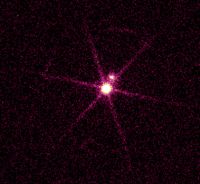
The nearest white dwarf to Earth is so called Sirius B at a distance of about 8.5 light years.

When two white dwarfs merge, their combined mass can exceed beyond a tipping point, leading to a supernova-like explosion.

Read more...